可预设程序,低功耗


概览
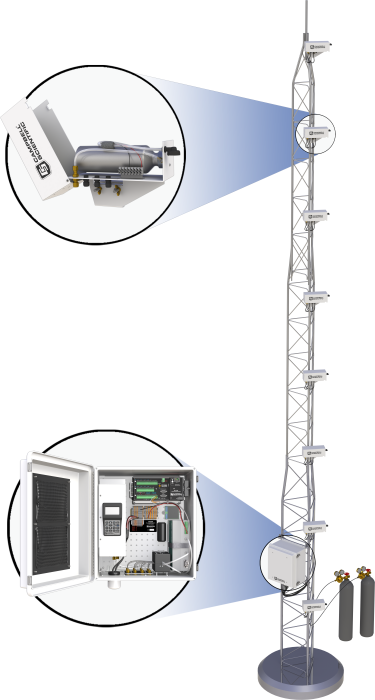
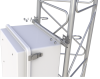
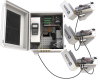
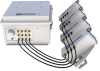
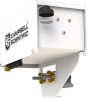
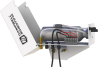
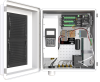
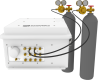
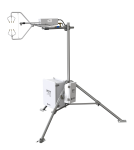
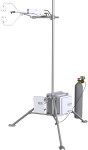
AP200是完整的集成的系统,测量CO2 和H2O 大气廓线系统。通过8个采样管测量二氧化碳(CO2)和水汽(H2O) 浓度,这些采样管通常位于塔的不同高度处,形成垂直剖面。AP200 常与涡度系统组合,测量储存项,为表面气体交换提供更完整的测量。
优势与特点
- Fully integrated system
- Requires only 13 W (average at 25°C and 12 Vdc)
- Contains a Campbell Scientific CR1000X Measurement and Control Datalogger
- Automatically performs CO2 zero and span
- Automated temperature and pressure control
- Data logger program included
图像


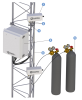
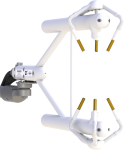
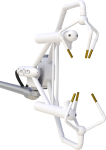

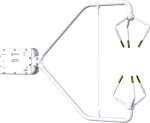
技术说明
测量
主要参数
- CO2在每个采样管的浓度
- H2O在每个采样管的浓度
- 系统诊断
其它参数
- 气样流速
- 样品室压力
- 样品室温度
- 其它控制变量
产品规格
System Enclosure |
|
| Operating Temperature | -30° to +45°C |
| Power Requirements |
|
| Dimensions | 52.1 x 44.5 x 29.7 cm (20.5 x 17.5 x 11.7 in.) |
| Weight |
|
Pump Module |
|
| Pump Type | Dual-head diaphragm pump with a brushless dc motor |
| Mounting | Mounted in an insulated, temperature-controlled box inside system enclosure |
| Control | Pumping speed is automatically controlled to maintain the pump inlet pressure at the set point |
| Maximum Pumping Speed | 9.0 liters per minute (LPM) |
| Pressure Sensor Range | 15.0 to 115.0 kPa |
| Heater | 8.0 W (turns on/off at 2°C) |
| Warm-up Time | ~50 min (from -30° to +2°C) |
| Fan | 0.7 W (turns on at 50°C and off at 45°C) |
Valve Manifold |
|
| Mounting | Mounted inside system enclosure |
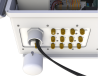
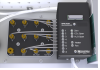
| Inlets | Eight air sample inlets plus one inlet for zero, one inlet for CO2 span, and one inlet for H2O span |
| Connections | 0.25-in Swagelok |
| Mass Flow Sensor | 0 to 1.0 standard liters per minute (SLPM) |
| Heater | 8.0 W (turns on/off at 5°C) |
| Warm-up Time | ~20 min (from -30° to +4°C) |
| Fan | 0.7 W (turns on at 45°C and off at 43°C) |
Intake Assembly |
|
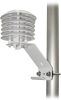
| Filter | 1.0-in diameter, sintered stainless-steel disk filter, 10-micron pore size |
| Orifice Heater | 2 kohm (0.07 W at 12 Vdc) |
| Mixing Volume | 750 mL |
| Sample Connection | 0.25 in. Swagelok |
| Number of Connections for Heater Cable Entry Seals | 3 (1 in, 2 out) |
| Cable Diameter for Heater Cable Entry Seals | 2.8 to 6.6 mm (0.11 to 0.26 in.) |
| Wire Diameter for Heater Cable Screw Terminals | 26 to 12 AWG |
| Wire Stripping Length for Heater Cable Screw Terminals | 5.0 mm (0.2 in.) |
| Screw Tightening Torque for Heater Cable Screw Terminals | 0.4 N•m |
| Orifice Inside Diameter | 0.178 mm (0.007 in.) |
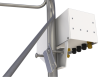
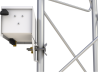
| Dimensions | 31 x 12.5 x 19 cm (12 x 5 x 7.5 in.) |
| Weight | 1.4 kg (3.1 lb) |
相关技术文档
下载
AP200 CR1000 Program v.2.01 (31.3 KB) 12-01-2021
AP200 CR1000(X) Program.
Compatible with the LI-850.
Note: For those with the LI-840 contact Campbell Scientific for compatible code.
Device Configuration Utility v.2.36 (52.1 MB) 17-09-2026
A software utility used to download operating systems and set up Campbell Scientific hardware. Also will update PakBus Graph and the Network Planner if they have been installed previously by another Campbell Scientific software package.
Supported Operating Systems:
Windows 11 or 10 (Both 32 and 64 bit)
常见问题解答
45102: 42
展开全部收起全部
-
If the dewpoint generator is already stable, and a short piece of Bevaline tubing is used to connect it to the AP200, then it should only take a few minutes for the H2O reading to stabilize.
-
Campbell Scientific recommends Synflex 1300 (pn 15702, Raw Plastic Tubing .250 in. OD). This tubing has a durable polyethylene jacket and an aluminum wrap to limit diffusion through the wall. The aluminum layer also makes this tubing easier to work with, as it does not tend to spring back into a coiled shape as much as other tubing types.
-
No. The tubing can be purchased from another vendor. When making a purchase, remember that Campbell Scientific recommends Synflex 1300, ¼ in. outer diameter (OD) tubing for the AP200.
-
The AP200 uses ¼ in. tube fittings. Tubing with a 6 mm outer diameter (OD) will not fit, unless a 6 mm to ¼ in. reducer is used on each end of each tube.
-
The intake heaters are wired in parallel, so that each heater sees a nominal 12 Vdc.
-
Adding sensors to the AP200 is not recommended.
-
No. Because the AP200 has only eight inlets for air samples, it can only operate with a maximum of eight intake assemblies.
-
Yes. The AP200 will work correctly with either an LI-840 or an LI-840A.
-
The expected precision for the half-hour average CO2 and H2O concentrations is 0.08 ppm for CO2 and 0.0008 ppt (0.8 ppm) for H2O. This is estimated as follows. The LI-840A maximum RMS noise specification is 1 ppm for CO2 and 0.01 ppt for H2O. Assuming the AP200 is configured with eight levels, it will switch to a new level every 15 s, cycling through the set of eight levels every two minutes. Each time the valves switch, the first 10 s are omitted for equilibration, and 5 s (10 samples) are included in the average. In each half-hour averaging period, each level will have a total of 150 samples (10 samples per cycle, and 15 cycles per half hour). The precision of the CO2 and H2O average concentrations can be given as the standard error of the mean. This is calculated as the RMS noise of individual samples divided by the square root of the number of samples, giving a precision of 0.08 ppm for CO2 and 0.0008 ppt (0.8 ppm) for H2O.
案例研究

This case study discusses the integration of CPEC310 and AP200 systems to explore the theories......阅读更多