从本地洞察到全球标准:如何选择适合你的气象站
通过 Jamie McDonald | 更新: 12/01/2025 | 评论: 0
博客主题


Product Category


搜索博客
订阅博客
出现新文章时获得邮件。选择您感兴趣的主题。
推荐文章
您是否想了解一个主题更多?请让我们知道。
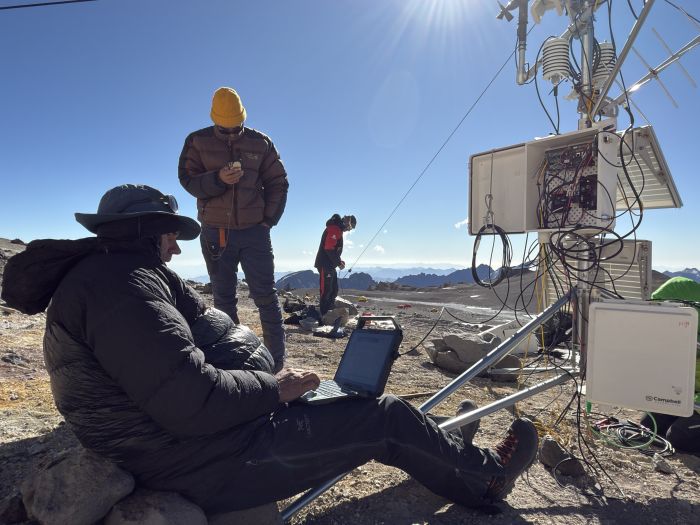
When it comes to weather and environmental observations, one weather station size won’t work for all scenarios. Whether you’re running a single research site, scaling up to a regional network, or managing a national meteorological network, selecting the right type of weather station can make all the difference.
At Campbell Scientific, we design systems in a range of tiers, whether you need a compact, Internet of Things (IoT) station or a full-scale station that is compliant with World Meteorological Organization (WMO) guidelines for national meteorological services. But how do you decide which tier is the best fit for you? In this article, we’ll explore the three main tiers of Campbell Scientific automatic weather stations (AWS) to help you find the perfect fit for your measurement needs:
- IoT-based
- Scalable
- Research-grade for large-scale deployments
Finding the Right Station Size for Your Project
Every monitoring need is different. Some projects require fast, affordable insights at a handful of sites using compact stations; other projects demand continuous, research-grade data to feed into national or global observation networks.
Choosing the right system depends on a few key factors:
- Measurement fidelity: How precise and reliable do your observations need to be?
- Scalability: Is this a stand-alone station or part of a growing network?
- Standards and compliance: Will your data be used for scientific research or operational forecasting and early warnings?
- Connectivity: What communications methods are available? Cellular, satellite, Ethernet, or something else?
- Cost and lifetime value: What’s your budget—not just for hardware, but also maintenance, calibration, and data management?
With these questions in mind, let’s take a closer look at three Campbell Scientific weather station examples for different purposes.
Tier 1: IoT-Based Weather Stations | Smart, Simple, and Agile
If you need dependable data without a complex setup, an IoT-enabled weather station is a smart starting point. These compact, cost-effective systems combine rugged Campbell Scientific sensors with simple plug-and-play storage and connectivity to deliver accurate, local data straight to your CampbellCloud™ dashboard.
Our Aspen™10 IoT Edge Device for a Single Sensor is compact and easy to deploy. With an integrated solar panel, it doesn’t need a separate power supply and can be set up and connected to CampbellCloud within 10 minutes. No coding is required; just plug in a compatible SDI-12 weather sensor—such as a ClimaVue™50 G2—and you’ve got a full suite of weather data at your fingertips in less time than it takes to read the Wikipedia page on IoT.
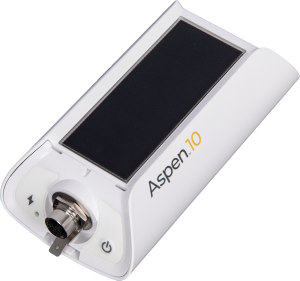
Aspen 10 IoT Edge Device for a Single Sensor
|
Recommended for You: Learn more about the Aspen 10 and its sensor combinations. |
These stations are ideal for:
- Filling in blank spots on an existing network
- Smart cities
- Hyper-local weather data from places not suitable for larger weather stations
- Educational or research projects
- Pilot monitoring sites or short-term deployments
Why they work:
- Affordable and fast to deploy: Simple installations mean you can start collecting data within minutes.
- Cloud ready: Integrated communications protocols allow direct connection to CampbellCloud for data visualization and manipulation.
- Low price point: With no technical knowledge required and a compact, powerful package at a low price point, IoT stations are perfect for quick deployment in any location where you need the data most.
Things to consider:
- These stations have a limited sensor suite compared to full-scale AWS or mesonet systems.
- Shorter tower heights may affect wind-related measurements.
- These stations are not intended for WMO or Global Basic Observing Network (GBON) compliance.
If you’re gathering baseline weather data, monitoring microclimates, or validating new sites before scaling up, this could be your tier.
Tier 2: Scalable Automatic Weather Stations (AWS) | The Reliable Workhorse
Moving up a tier, AWS provide a more advanced, scalable solution for organizations managing multiple sites or requiring high-quality, long-term data.
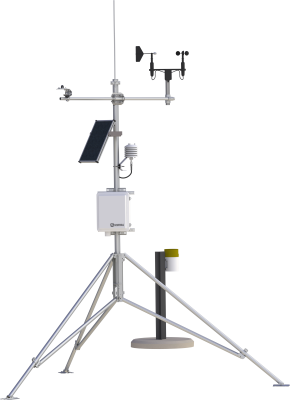
WxPRO™Research-Grade Entry-Level Weather Station
These systems, in use for decades in different formats, are the backbone of many regional weather networks and environmental observation organizations. Rugged, configurable, and built around Campbell Scientific’s renowned data loggers, these stations give you the flexibility to add all your needed measurement parameters, each measured by a dedicated sensor.
|
Recommended for You: Refer to examples of our AWS systems. |
These stations are ideal for:
- Regional environmental networks
- Research institutions and universities
- Long-term installations that require rugged durability (atop Mount Everest and Aconcagua!)
- Agricultural meteorological measurement needs
- Industrial operations or utilities managing large areas
- Professional-grade sensors: Accurate, research-quality measurements with robust calibration support
- Network scalability: Multiple AWS units managed via a unified data platform, such as CampbellCloud
- Flexible communications: Multiple communications options to choose from to best suit your needs
- Longevity: Proven durability and typically minimal maintenance needs
Things to consider:
- Higher initial investment than an IoT installation
- Could require installation planning and some technical knowhow (We can help you with our training courses and installation team.)
- May not meet full WMO/GBON specifications (depending on configuration)
If your goal is a reliable, scalable network that balances cost, accuracy, and data accessibility, the AWS tier is your ideal middle ground.
Tier 3: Full Research-Grade, Mesonet-Style Systems | For Large-Scale Networks
The top tier features WMO-compliant, mesonet-style systems, the benchmark for meteorological networks that propagate national and global data systems.
These systems can meet or exceed WMO and GBON standards, delivering long-term, research-grade observations that inform climate models, early warning systems, and public weather services.
Our ClimaPRO™ and MeteoPRO™ weather stations are ideally suited for national weather monitoring networks. Built around our flagship CR1000Xe Measurement and Control Datalogger, these durable and reliably constructed stations combine world-class sensors to measure and record essential meteorological parameters to ensure continuous data flow.
These types of stations have been installed by national meteorological services around the world, including in the first-ever Systematic Observations Financing Facility (SOFF)-funded GBON tender in Rwanda.
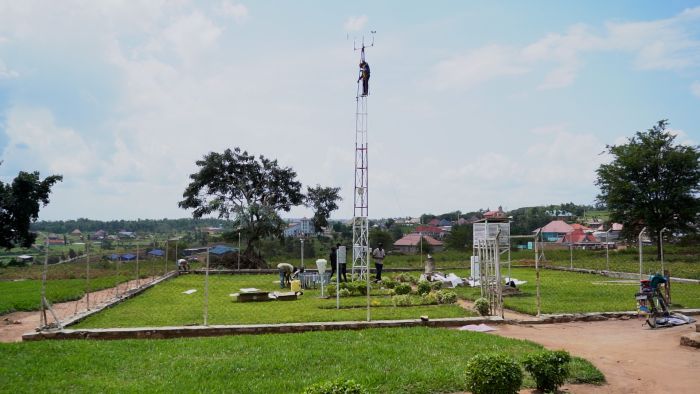
Rwanda automated weather station
|
Recommended for You: Learn more about our work with the Rwanda Meteorology Agency. This case study includes links to a related video and press release. The press release highlights Campbell Scientific receiving the prestigious Varysian Hydrometeorological Award for Best Weather Observation Technology for this project. |
These stations are ideal for:
- National Meteorological and Hydrological Services (NMHS)
- Climate monitoring and wide-scale early warning systems
- Research consortia and global networks
- Long-term environmental baselines
Why they work:
- Standards-compliant instrumentation: Full suite of WMO-compliant sensors, including wind, temperature, humidity, precipitation, radiation, and pressure
- Robust infrastructure: Engineered towers, power systems, and communications solutions for any environment
- Integration with WMO Information System 2.0 (WIS 2.0): Seamless data exchange with global meteorological systems
Things to consider:
- High initial capital and ongoing maintenance costs
- Skilled technical personnel needed—whether current employees or contracted, such as with Campbell Scientific
- While ideal for national-level installations requiring the highest-quality measurements of many weather parameters, may exceed the needs of smaller operations
If your mission involves national-scale weather or climate services, this is the tier you’ll want to consider.
Which tier fits your needs best?
Here’s a quick comparison to help guide your decision:
| Feature | IoT-Based | Scalable AWS | Research-Grade Mesonet/WMO-Compliant |
|---|---|---|---|
| Typical Use Case | Local or micro-site monitoring, education, pilot studies, smart cities | Regional networks, research institutions, industrial or environmental monitoring | National meteorological networks, WMO-compliant climate and early warning systems |
| Example Station | Aspen 10 with ClimaVue 50 G2 | WxPRO™ or MetPRO™ | ClimaPRO or MeteoPRO |
| Sensor Suite | Single-parameter sensors or compact all-in-one for good general accuracy | Dedicated sensors for each parameter, research-grade precision | Option for full WMO/GBON-compliant instrumentation suite |
| Connectivity | IoT (cellular) direct to CampbellCloud, quick plug-and-play | Many options depending on your needs and site | Many options depending on your needs and site |
| Deployment and Maintenance | < 10 minutes for setup, minimal upkeep, solar-powered | Planned installation, moderate technical setup, and periodic calibration | More demanding setup requiring skilled installation and ongoing maintenance to ensure strict quality assurance/quality control |
| Investment Level | Low with fast, affordable entry point | Mid-range with long-term value | Premium with infrastructure-level investment |
Best Practices Across All Tiers
No matter which tier you choose, a few fundamentals always apply:
- Site selection matters. Avoid obstructions, ensure representative placement, and maintain proper tower height for the sensors you choose.
- Maintenance is essential. Calibrate sensors (or ask us to), inspect mounts, and validate data regularly.
- Data management counts. Plan for reliable data retrieval, quality control, and archiving from the outset.
From One Station to a Whole Nation
From IoT-based single stations to WMO-compliant national meteorological monitoring networks, Campbell Scientific offers a spectrum of weather monitoring solutions that grow with your mission.
Whether you’re helping communities avoid localized flooding, supporting research into local climate impacts, or contributing to the global weather network, there’s a Campbell Scientific weather station designed for you. Because when it comes to data quality and reliability, only the best will do.
Interested in learning more?
Talk to a Campbell Scientific specialist to discuss your application, or explore our product tiers:
- Campbell Scientific IoT Weather Stations
- Automatic Weather Stations (AWS)
- Research-Grade, Mesonet-Style Solutions
Credits: Main photo is used with permission and was created by Pablo Betancourt.


关于作者
 Jamie McDonald is the Hydromet Marketing Manager at Campbell Scientific. He focuses on bringing Campbell Scientific environmental monitoring solutions to life through storytelling, ensuring that our customers understand the value that Campbell Scientific brings to help solve their measurement challenges. Based in Finland, he holds a Master of Arts degree in International Relations, and he is currently pursuing a Bachelor of Science degree in Energy Technology.
建议
Please log in or register to comment.