设计用于长期监测


概览
CS616测量从 0% 到水饱和的体积含水量。探头输出百万赫兹的振荡频率,按比例下降,容易被Campbell Scientific数据采集器所读取。
优势与特点
- Compatible with most Campbell Scientific data loggers
- High accuracy and high precision
- Fast response time
- Designed for long-term unattended water content monitoring
- Compatible with AM16/32-series multiplexers, allowing measurement of multiple sensors
- Probe rods can be inserted from the surface or buried at any orientation to the surface.
图像

技术说明
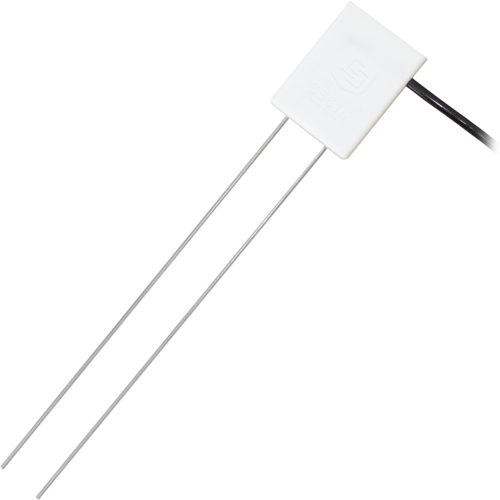
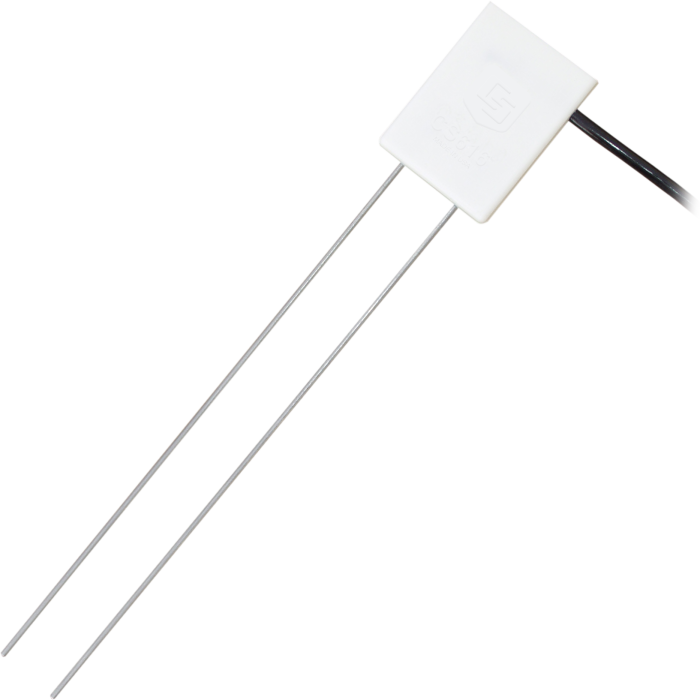
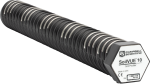
CS616含有连接到测量电子单元的2根30 cm长的不锈钢探针。电路板用环氧树脂封装,连接到电路板的4芯带屏蔽线缆给探头提供电源、激活测量以及监测输出信号。
CS616采用时域反射技术测量多孔介质(例如土壤)的体积含水量。类似TDR100的时域反射主机(测线器)对于CS616并不需要。CS616生成电磁脉冲,消逝行程时间和脉冲反射继而被测量,用于计算土壤体积含水量。
响应特征
沿CS616平行探针传输的信号被土壤溶液中的自由离子和土壤矿物成分的导电组分所消弱。在大多数应用中,该衰减并不足以影响CS616对土壤含水量变化的响应。CS616的响应曲线较好地被标准校准所描述。不过,在较大电导率的土壤、压实土、或较高粘土矿物含量的土壤中,应该特定土壤调整校准曲线。在CS616说明书提供了做这些校准调整的指导。
产品规格
| Measurements Made | Volumetric water content (VWC) of porous media (such as soil) |
| Measurement Range | 0% to saturation |
| Water Content Accuracy | ±2.5% VWC (using standard calibration with bulk EC of ≤ 0.5 dS m-1, bulk density of ≤ 1.55 g cm-3, and measurement range of 0% to 50% VWC) |
| Required Equipment | Measurement system |
| Soil Suitability | Long rods and lower frequency are well-suited for soft soil with low electrical conductivity (< 2 dS/m). |
| Rods | Not replaceable |
| Sensors | Not interchangeable |
| Operating Temperature Range | 0° to +70°C |
| Probe-to-Probe Variability | ±0.5% VWC in dry soil, ±1.5% VWC in typical saturated soil |
| Precision | Better than 0.1% VWC |
| Resolution | 0.1% VWC |
| Output | ±0.7 V square wave (with frequency dependent on water content) |
| Current Drain |
|
| Power Supply Voltage | 5 Vdc minimum; 18 Vdc maximum |
| Enable Voltage | 4 Vdc minimum; 18 Vdc maximum |
| Electromagnetic | CE compliant (Meets EN61326 requirements for protection against electrostatic discharge.) |
| Rod Spacing | 32 mm (1.3 in.) |
| Rod Diameter | 3.2 mm (0.13 in.) |
| Rod Length | 300 mm (11.8 in.) |
| Probe Head Dimensions | 85 x 63 x 18 mm (3.3 x 2.5 x 0.7 in.) |
| Cable Weight | 35 g per m (0.38 oz per ft) |
| Weight | 280 g (9.9 oz) without cable |
兼容性
Please note: The following shows notable compatibility information. It is not a comprehensive list of all compatible products.
数据采集器
| Product | Compatible | Note |
|---|---|---|
| CR1000X (retired) | ||
| CR1000Xe | ||
| CR300 (retired) | ||
| CR3000 (retired) | ||
| CR310 | ||
| CR350 | ||
| CR6 | ||
| CR800 (retired) | ||
| CR850 (retired) |
Additional Compatibility Information
RF Considerations
The RF emissions are below FCC and EU limits as specified in EN61326 if the CS616 is enabled less than 0.6 ms, and measurements are made less frequently than once a second. External RF sources can also affect the CS616 operation. Consequently, the CS616 should be located away from significant sources of RF such as ac power lines and motors.
Installation Tool
The CS650G makes inserting soil-water sensors easier in dense or rocky soils. This tool can be hammered into the soil with force that might damage the sensor if the CS650G was not used. It makes pilot holes into which the rods of the sensors can then be inserted. It replaces both the 14383 and 14384.
Data Logger Considerations
The reflectometer connects directly to one of the data logger’s single-ended analog inputs. A data logger control port is typically used to enable the CS616 for the amount of time required to make the measurement. Data logger instructions convert the probe square-wave output to period which is converted to volumetric water content using a calibration.
相关技术文档
技术论文

常见问题解答
CS616: 31
展开全部收起全部
-
Running the cable through electrical conduit or PVC pipe will protect the cable from rodents. A trench 30 to 60 cm deep will protect it from most other human or animal activity. Some customers have found that extra cable can be coiled and left inside a box, such as an irrigation valve box or something similar. When using a box, seal any holes that are large enough for rodents to enter. When cables are exposed on the ground surface, some customers have found that wrapping the cables in the metal screening used for screen doors discourages animals from chewing on them.
-
The CS616/CS625 will survive frozen soil conditions, but the principle behind using bulk soil dielectric permittivity to estimate water content requires that the water be in liquid form. When soil water freezes, its dielectric drops from approximately 80 to 4, making it indistinguishable from soil solids. Consequently, the CS616/CS625 is not able to measure the water content of frozen soil.
-
- The CS616/CS625 is not receiving power. Ensure that the red wire is well connected to 12V and that the black and clear wires are both connected to G. Also check that the orange wire is well connected to a control port and that the data logger program references that control port as part of the sensor measurement.
- The data logger is not receiving a signal from the CS616/CS625. Ensure that the green wire is well connected to a single-ended analog input channel and that the data logger program references that channel in the CS616() or PeriodAvg() instruction.
- The soil is too conductive. If the soil has high electrical conductivity, high clay content, or high organic matter content and the CRBasic instruction CS616() or Edlog instruction P138 is used, the period might be out of range for that instruction. In that situation, it may be possible to use PeriodAvg() or P27 as shown in the program examples of the CS616 and CS625 instruction manual.
-
No. The output is too fast to be measured on the pulse channel of a 21X or CR7.
-
Campbell Scientific does not recommend splicing sensor cables. Sensors may be ordered with custom cable lengths, and Campbell Scientific recommends purchasing the correct length for the application. If the sensor cable needs to be lengthened, a junction box (if practical) is a more favorable option than a splice.
Note: A splice will void the sensor warranty, but a junction box does not modify the sensor and therefore does not void the warranty.
-
No. Although the CS616/CS625 could be calibrated to convert its period reading to the dielectric permittivity of snow, there is not an easy way to relate the permittivity to liquid water content. This is because the density of snow changes over time and the amount of liquid water that can be held in the solid matrix is relatively small. Additionally, the sensor emits infrared radiation that melts snow away from its rods, similar to the way snow melts around the base of a tree.
The CS616 and CS625 are not appropriate sensors for this application because of the lack of good contact between the rods and the snow, as well as the dynamic nature of the solid matrix.
-
If a soil-specific calibration is performed, the CS616/CS625 may be used in soil with a maximum bulk electrical conductivity of 5 dS/m.
-
If the electrical conductivity within the waste is less than 5 dS/m and there is good contact between the probe rods and the waste, the CS616/CS625 should respond predictably to changes in water content. The heterogeneous nature and changing bulk density of solid waste, however, make calibration difficult.
-
Yes. The rugged design of the CS616/CS625 protects the probe electronics from water under these conditions. Many CS616/CS625 reflectometers have been working reliably in very wet conditions for more than ten years.
-
Some customers have tried to use the CS616 or CS625 to measure the moisture content within a tree, but the calibration proved to be problematic. Campbell Scientific cannot provide any specific guidance for this application.
案例研究
Tropical volcanic islands are biodiversity hotspots where the Critical Zone (CZ) remains poorly studied. In......阅读更多
Korea Expressway Corporation (KEC) was established in 1969 to construct and manage expressways throughout South......阅读更多
The Delaware Environmental Observing System (DEOS) is a real-time system dedicated to monitoring environmental conditions......阅读更多