

概览
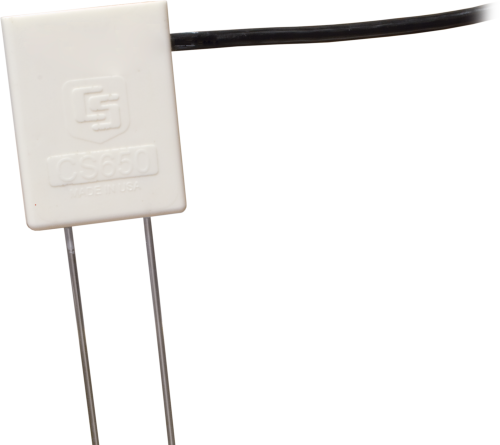
CS655 是多参数智能传感器,使用革新的技术监测土壤体积含水量、容积电导率和土壤温度。它的信号输出方式为SDI-12,可用于大多数的 Campbell Scientific 数据采集器。探针长度比CS650更短,适合使用在基岩类土壤中。
备注:如果用于ET107气象站,请选择CS655-LC。
优势与特点
- 更大的采集体积,减少了误差
- 对土壤质地和电导率的影响进行测量修正
- 估算很多种矿质土类型土壤中的含水量
- 多功能的传感器 — 可测量介电常数、容积电导率(EC)和土壤温度
图像

技术说明
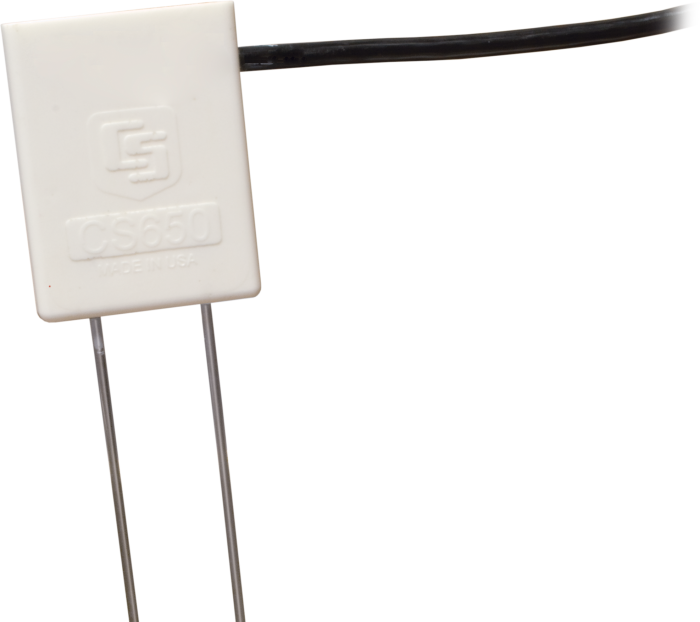
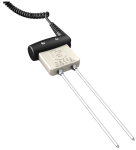
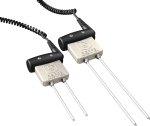
The CS655 consists of two 12-cm-long stainless steel rods connected to a printed circuit board. The circuit board is encapsulated in epoxy and a shielded cable is attached to the circuit board for data logger connection.
The CS655 measures propagation time, signal attenuation, and temperature. Dielectric permittivity, volumetric water content, and bulk electrical conductivity are then derived from these raw values.
Measured signal attenuation is used to correct for the loss effect on reflection detection and thus propagation time measurement. This loss-effect correction allows accurate water content measurements in soils with bulk EC ≤8 dS m-1 without performing a soil-specific calibration.
Soil bulk electrical conductivity is also calculated from the attenuation measurement. A thermistor in thermal contact with a probe rod near the epoxy surface measures temperature. Horizontal installation of the sensor provides accurate soil temperature measurement at the same depth as the water content. Temperature measurement in other orientations will be that of the region near the rod entrance into the epoxy body.
产品规格
| Measurements Made | Soil electrical conductivity (EC), relative dielectric permittivity, volumetric water content (VWC), soil temperature |
| Required Equipment | Measurement system |
| Soil Suitability | Short rods are easy to install in hard soil. Suitable for soils with higher electrical conductivity. |
| Rods | Not replaceable |
| Sensors | Not interchangeable |
| Sensing Volume | 3600 cm3 (~7.5 cm radius around each probe rod and 4.5 cm beyond the end of the rods) |
| Electromagnetic | CE compliant (Meets EN61326 requirements for protection against electrostatic discharge and surge.) |
| Operating Temperature Range | -50° to +70°C |
| Sensor Output | SDI-12; serial RS-232 |
| Warm-up Time | 3 s |
| Measurement Time | 3 ms to measure; 600 ms to complete SDI-12 command |
| Power Supply Requirements | 6 to 18 Vdc (Must be able to supply 45 mA @ 12 Vdc.) |
| Maximum Cable Length | 610 m (2000 ft) combined length for up to 25 sensors connected to the same data logger control port |
| Rod Spacing | 32 mm (1.3 in.) |
| Ingress Protection Rating | IP68 |
| Rod Diameter | 3.2 mm (0.13 in.) |
| Rod Length | 120 mm (4.7 in.) |
| Probe Head Dimensions | 85 x 63 x 18 mm (3.3 x 2.5 x 0.7 in.) |
| Cable Weight | 35 g per m (0.38 oz per ft) |
| Probe Weight | 240 g (8.5 oz) without cable |
Current Drain |
|
| Active (3 ms) |
|
| Quiescent | 135 µA typical (@ 12 Vdc) |
Electrical Conductivity |
|
| Range for Solution EC | 0 to 8 dS/m |
| Range for Bulk EC | 0 to 8 dS/m |
| Accuracy | ±(5% of reading + 0.05 dS/m) |
| Precision | 0.5% of BEC |
Relative Dielectric Permittivity |
|
| Range | 1 to 81 |
| Accuracy |
|
| Precision | < 0.02 |
Volumetric Water Content |
|
| Range | 0 to 100% (with M4 command) |
| Water Content Accuracy |
|
| Precision | < 0.05% |
Soil Temperature |
|
| Range | -50° to +70°C |
| Resolution | 0.001°C |
| Accuracy |
|
| Precision | ±0.02°C |
兼容性
Please note: The following shows notable compatibility information. It is not a comprehensive list of all compatible products.
数据采集器
| Product | Compatible | Note |
|---|---|---|
| CR1000X (retired) | ||
| CR300 (retired) | ||
| CR3000 (retired) | ||
| CR310 | ||
| CR350 | ||
| CR6 | ||
| CR800 (retired) | ||
| CR850 (retired) |
Additional Compatibility Information
RF Considerations
External RF Sources
External RF sources can affect the probe’s operation. Therefore, the probe should be located away from significant sources of RF such as ac power lines and motors.
Interprobe Interference
Multiple CS655 probes can be installed within 4 inches of each other when using the standard data logger SDI-12 “M” command. The SDI-12 “M” command allows only one probe to be enabled at a time.
Optional Installation Tool
CS650G Rod Insertion Guide Tool
The CS650G makes inserting soil-water sensors easier in dense or rocky soils. This tool can be hammered into the soil with force that might damage the sensor if the CS650G was not used. It makes pilot holes into which the rods of the sensors can then be inserted.


下载
CS650 / CS655 Firmware v.2 (429 KB) 02-12-2015
Current CS650 and CS655 firmware.
Note: The Device Configuration Utility and A200 Sensor-to-PC Interface are required to upload the included firmware to the sensor.
常见问题解答
CS655: 51
展开全部收起全部
-
The CWS655 is a wireless sensor with measurement electronics, radio, and power supply all integrated in a single device. The CWS655, however, requires the use of a CWB100 base station radio connected to a data logger. Only the rods of the CWS655 should be buried in the soil; burying the body of the CWS655 will prevent the sensor from communicating with the CWB100.
The CS655 is a cabled multiparameter smart sensor that sends data by RS-232 serial or SDI-12 communication through a direct connection to a data logger. The CS655 is suitable for burial at any depth.
-
No. It is not possible to disable the logical tests in the firmware. If soil conditions cause frequent NAN values, it may be possible to perform a soil-specific calibration that will provide good results.
If permittivity is reported but the volumetric water content value is NAN, Campbell Scientific recommends a soil-specific calibration that converts permittivity to water content. This will take advantage of the bulk electrical conductivity correction that occurs in the firmware.
If both permittivity and volumetric water content have NAN values, it may be possible to perform a calibration that converts period average directly to volumetric water content.
For details on performing a soil-specific calibration, refer to “The Water Content Reflectometer Method for Measuring Volumetric Water Content” section in the CS650/CS655 manual. After a soil-specific equation is determined, it may be programmed into the data logger program or used in a spreadsheet to calculate the soil water content.
-
Campbell Scientific strongly discourages shortening the sensor’s rods. The electronics in the sensor head have been optimized to work with the 12 cm long rods. Shortening these rods will change the period average. Consequently, the equations in the firmware will become invalid and give inaccurate readings.
-
Modifications to the CS650 or CS655, including shortening the cable, will void the warranty. However, shortening the cable will not affect the sensor’s performance. If a decision is made to shorten the cable, care should be taken to avoid damaging the cable jacket and exposing bare wire except at the ends that connect to the data logger or multiplexer terminals.
-
If a system has multiple CS650 or CS655 sensors, it will be necessary to connect many wires to a 12 V supply and many wires to ground. The DIN Rail Mounting Kit is useful for attaching many wires to the same source in a clean and organized way. For more details, see the 5458 DIN Rail Terminal Kit instruction manual.
Other methods of connecting several wires together, such as terminal strips or wire nuts, would also work.
-
Yes, but the pots would have to be large. The CS650 and CS655 can detect water as far away as 10 cm (4 in.) from the rods. If the pot has a diameter smaller than 20 cm (8 in.), the sensor could potentially detect the air around the pot, which would underestimate the water content. In addition, potting soil is typically high in organic matter and clay, causing the probable need for a soil-specific calibration.
-
The electrical conductivity (EC) of sea water is approximately 48 dS/m. The CS655 can measure permittivity in water with EC between 0 and 8 dS/m. EC readings become extremely unstable at conductivities higher than 8 dS/m and are reported as NAN or 9999999. Because EC is part of the permittivity equation, an EC reading of NAN leads to a permittivity reading of NAN as well. Thus, the CS655 cannot provide good readings in sea water.
With regard to sea ice, the electrical conductivity drops significantly when sea water freezes and the permittivity changes from approximately 88 down to approximately 4, as the water changes from a liquid to a solid state. With both EC and permittivity falling to levels that are within the CS655 measurement range, the sensor is expected to give valid readings in sea ice. The sensor is rugged and can withstand the cold temperatures. However, as the ice melts, there will be a point at which the electrical conductivity becomes too high to acquire a valid reading for either permittivity or electrical conductivity.
-
No. The temperature sensor is located inside the sensor’s epoxy head next to one of the sensor rods. The stainless-steel rods are not thermally conductive, so the reported soil temperature reading is actually the temperature of the sensor head. If the CS650 or the CS655 is installed horizontally, which is the preferred method, then the sensor head will be at the same temperature as the soil, and the soil temperature value will be accurate. However, if the sensor is installed vertically, and/or with the sensor head above ground, the soil temperature reading will be less accurate. Because the sensor orientation is not known, no temperature correction was written into the firmware.
-
The CS650/CS655 manual gives a temperature correction that works in coarse sand, but it should be used cautiously with other soil types. If a temperature correction is required, it is best to determine a soil-specific temperature correction.
When correcting for temperature, the following effects contribute to the sensor output:
- The effect of temperature on the measurement electronics inside the sensor head. This is a relatively small effect compared to other temperature effects.
- The change in the dielectric permittivity of water with temperature. At 0°C, the permittivity of water is approximately 88, at 20°C it is approximately 80, and at 70°C it is approximately 64. If the sensor is in a soil at any given water content, the changing permittivity of water will cause the period average at 0°C to be higher than it is at 20°C. The same soil will have a lower period average at 70°C than at 20°C. In other words, the sensor will overestimate water content at colder temperatures and underestimate it at warmer temperatures. However, that is only true if electrical conductivity is negligible.
- The change in water content as bound water is captured and released. In soils with high clay content, some of the water is partially or fully immobilized by electrical charges on the surface of the clay minerals. The amount of bound water is temperature dependent and may have a small effect on the sensor readings.
- The temperature effect of bulk electrical conductivity (EC) on period average. Bulk electrical conductivity increases with temperature; as it increases, it slows down the period average.
The interaction of these effects may be complicated. For example, with increasing temperature, two things happen at the same time: the falling permittivity of water is decreasing the period average, and the increasing EC is increasing the period average. The net result as to whether the period average goes up or down depends on how conductive the soil is and the contributions of the other temperature effects.
-
The dielectric of water at room temperature is close to 80. The firmware for both the CS650 and the CS655 is programmed to change volumetric water content to NAN or 9999999 when the permittivity measurements are greater than 42. When testing in water, look at the permittivity reading rather than the water content reading. If a test is being done for functionality, pull the sensor about halfway out of the water to see both permittivity and volumetric water content readings.
案例研究

At the northern edge of Jamaica, fresh water from a limestone aquifer and the Martha......阅读更多
The Utah Geological Survey, supported by the Utah Division of Water Rights, has constructed a......阅读更多
International partnerships for sustainable innovations Improved water use in agriculture is essential to successfully adapt to......阅读更多

This case study discusses the integration of CPEC310 and AP200 systems to explore the theories......阅读更多